What is Thread Lifting? Your Complete Guide to a Non-Surgical Facelift
Noticing changes in your skin is a natural part of life, and it’s completely normal to have questions about how to address them. The face is one of the first areas where aging becomes visible. Over time, skin loses elasticity, facial muscles sag, and areas like the cheeks, jawline, and under the chin can develop a double-layered or drooping appearance.
This isn’t always due to weight gain—sagging skin and loss of volume often play a bigger role. Factors such as fat distribution, a naturally receding lower jaw, or skeletal structure can also contribute to facial unevenness and the appearance of aging.
With the rise of mask-wearing, many people have become more aware of changes in their chin and jawline, sparking interest in solutions like thread lifting—even among younger generations.
What is Thread Lifting?
Thread lifting is a minimally invasive cosmetic treatment designed to lift and tighten sagging skin. It uses safe, dissolvable threads to provide a subtle but noticeable lift while encouraging the skin to produce collagen over time.
Thread lifts can be an excellent solution for anyone noticing sagging, volume loss, or changes in facial definition, but who is not ready for surgery. With immediate lifting effects and minimal downtime, it provides a practical way to refresh your appearance and restore confidence in your facial profile.
Expert Insights
"Thread lifting is a procedure that involves inserting medical thread directly into the skin to tighten it from within, improving elasticity and smoothing wrinkles. It also improves sagging facial lines, skin texture, and tone."
— Dr. Dong-Hyeon Yoon, Director of Edit Plastic Surgery Clinic
How It Works
It is reassuring to know that the long-term results of a thread lift actually come from your body’s own natural ability to rejuvenate.
While the threads provide immediate support, their most important role is guiding your skin to rebuild itself through a simple, three-step process:
Immediate Support: Once placed, the threads act as a gentle frame beneath the surface, giving your skin the structure it needs to sit higher and tighter.
Natural Activation: Your body recognizes this frame and activates fibroblasts (repair cells), which start wrapping the threads in new layers of collagen and elastin.
Lasting Results: Even after the threads safely dissolve (usually within 6–12 months), that newly built structure remains, helping you maintain a firmer, refreshed look from the inside out.
Types of Thread Liftings
Thread lifting has evolved into a popular, minimally invasive alternative to surgical facelifts. Different types of threads are designed to target various skin concerns, from mild sagging to deeper folds, while stimulating collagen production for firmer, younger-looking skin.
Here are the most common types currently popular:
1. PDO Threads (Polydioxanone)
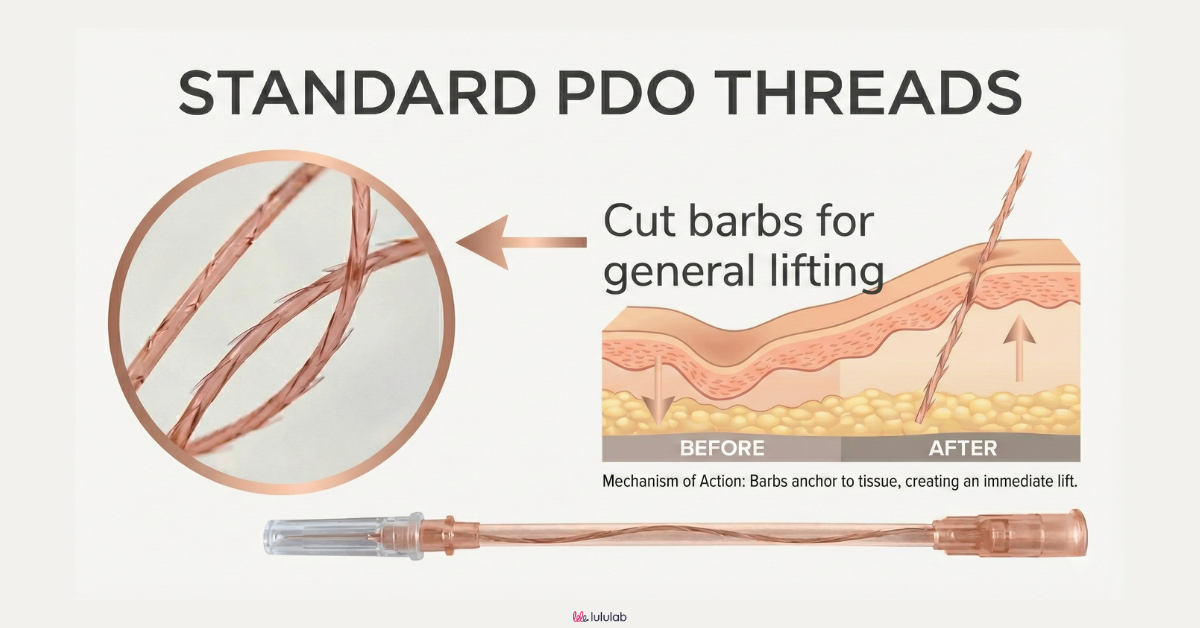
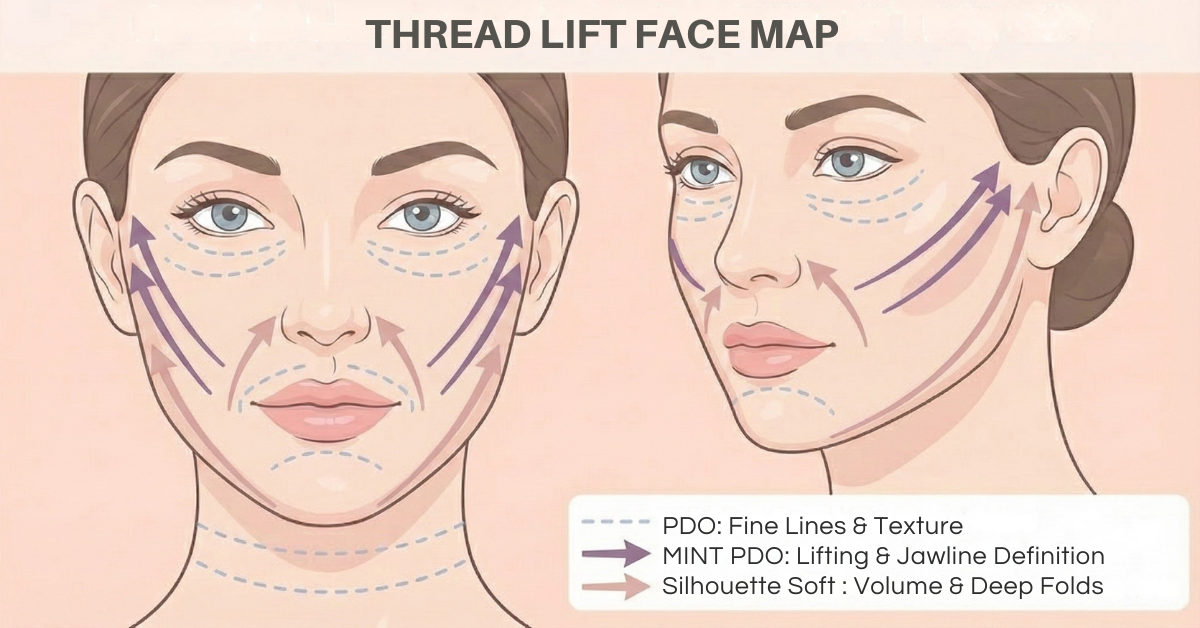
PDO threads are the most versatile option. Made from the same safe, biodegradable material used in medical sutures, they are fantastic for general skin tightening and defining contours.
How They Differ: They are often used in combination. You might use smooth threads to thicken thinning skin and barbed threads to pull it back.
Types of PDO Threads:
- Mono Threads: Smooth threads that improve skin texture and elasticity, ideal for fine lines and overall skin tightening.
- Cog Threads: Barbed threads that latch onto tissue for a more noticeable lift, commonly used for cheeks, jawline, and neck.
- Screw Threads: Twisted threads that add subtle volume and support in areas like cheeks or under the eyes.
Benefits:
→ Generally, it has the mildest recovery time
→ Can treat delicate areas like under-eyes and neck lines where heavier threads can't go
→ Excellent for smoothing "crepey" skin texture
Best For: Mild to moderate sagging on cheeks, jawline, neck, and brows.
2. MINT PDO Threads
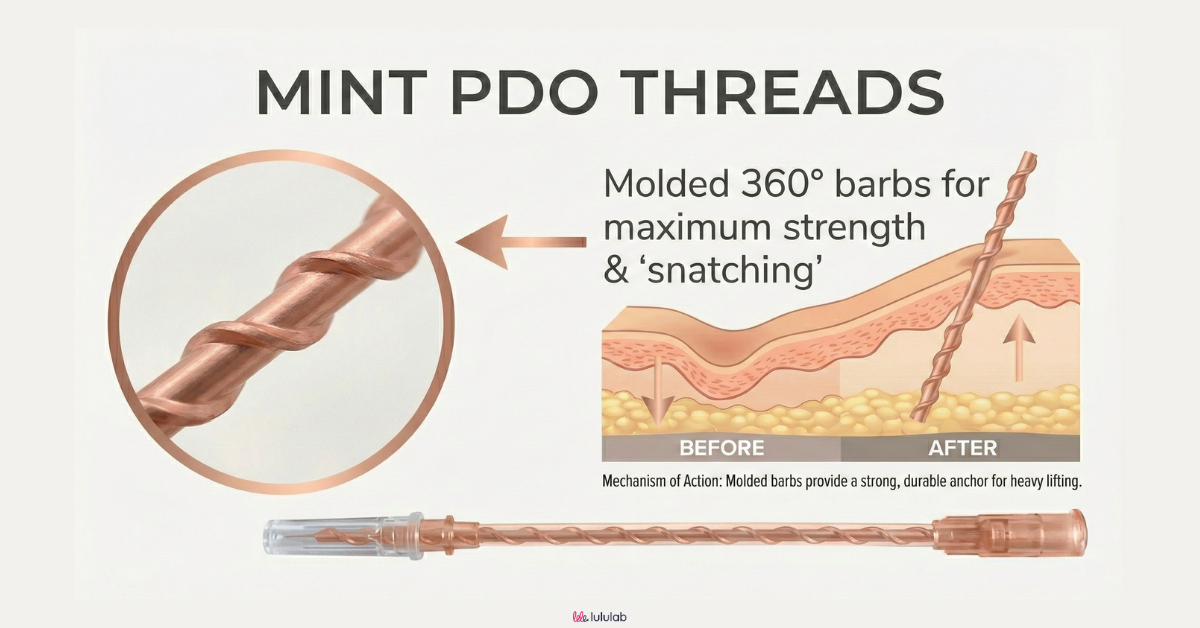
MINT (Minimally Invasive Nonsurgical Thread) is a premium upgrade to the standard PDO thread, designed specifically for mechanical strength.
How They Differ: Standard threads have barbs cut into the core, which can weaken them. MINT threads use molded barbs (pressed into a 360° spiral). This means the core of the thread is thicker, stronger, and much harder to break.
Benefits:
→ The molded barbs anchor deeper into the tissue, making them less likely to slip.
→ Offers the strongest immediate pull of any PDO thread.
→ Collagen remodeling continues even after threads dissolve
Best For: Defining a sharp jawline ("snatching"), lifting heavier cheeks, and reducing the appearance of a double chin.
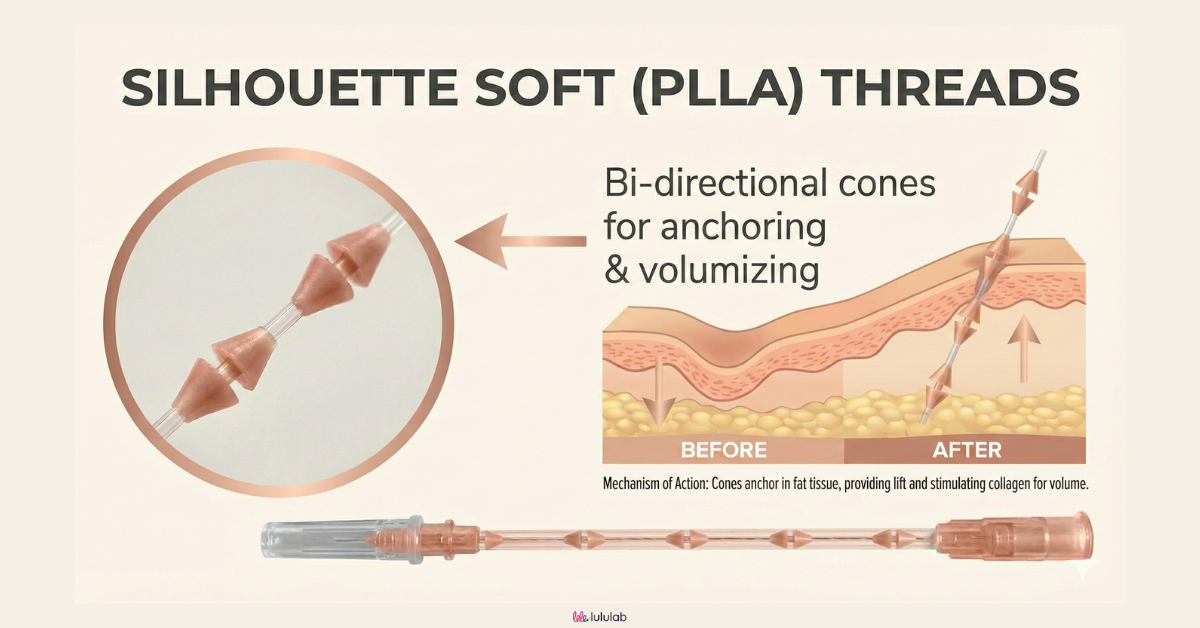
3. Silhouette Soft / PLLA Threads (Poly-L-Lactic Acid)
Silhouette Soft threads are unique because they are made from PLLA (Poly-L-Lactic Acid), a material often used in volumizing fillers.
How They Differ: Instead of barbs, these threads use tiny bi-directional cones. These cones act like reliable anchors in the subcutaneous fat, providing a solid suspension point.
Benefits:
→ Lifts the skin and restores lost volume (plumping) as the PLLA material breaks down
→ The cones provide a stronger anchor in soft tissue (fat) compared to standard barbs
→ PLLA typically lasts longer than PDO, with results often visible for 18–24 months
Best For: Mid-face volume loss (hollow cheeks), deep nasolabial folds, and patients who want to look "plumped" and refreshed rather than just pulled tight.
Summary of Each Type’s Unique Benefits Include:
Standard PDO: Versatility (can go where others can't, like eyes/neck).
MINT: Strength (Molded barbs don't snap; better for jawlines).
Silhouette: Volume (Restores fullness; better for hollow cheeks).
Risks and Side Effects of Thread Lifting
Your safety and comfort are paramount. While a thread lift is a safe non-surgical option, being informed helps you feel more in control.
The procedure is performed under local anesthesia to minimize discomfort. Afterward, it is normal to experience:
- Mild swelling or bruising.
- Mild pain or tenderness near the hairline.
- Skin dimpling usually settles as the skin relaxes.
In rare cases, threads may shift slightly from their original position, which can affect symmetry or make the texture faintly visible. This underscores the importance of choosing a provider with a deep understanding of facial anatomy, ensuring the threads are placed precisely to support safe healing.
Is Thread Lifting Right for You?
Since every face is different, starting with an AI Skin Analysis can help you understand your skin’s condition and see if thread lifting is the best fit for your needs.
Ideal Candidates
Thread lifting may be a good option for:
- Individuals in their late 30s to 50s with mild to moderate age-related skin sagging
- Those looking to tighten sagging skin and subtly soften nasolabial folds
- People seeking a refreshed, youthful appearance without general anesthesia or surgery
- Individuals who prefer a personalized treatment plan with minimal downtime
When to Consider Other Options
Thread lifting may not be ideal for:
→ Severe skin sagging: Excess skin may respond better to a surgical lift
→ Very thin or fragile skin: Threads may become visible or less effective
→ Heavy or dense tissue: A combination treatment approach may be needed to achieve and maintain lift
An AI Skin Analysis helps guide this decision, ensuring the treatment is tailored to your skin’s unique needs and delivers balanced, natural-looking results.
Thread Lifting for Your LuluTI Skin Type: Who Sees the Best Results
Before choosing a procedure, it helps to understand your skin. LuluTI is your personalized 4-letter “Skin Code”, generated by an AI-powered skin analysis tool that analyzes 9 key metrics, including elasticity and texture, to give a clear, data-driven view of your skin.
Once you have your personalized code, you can see if this treatment aligns with your specific skin profile.
From the LuluTI perspective, thread lifting is best suited for skin types with a “W” (Wrinkle/loss of firmness) profile, particularly when loss of elasticity and sagging facial contours are present. By lifting and repositioning soft tissue while stimulating collagen production, thread lifting helps restore firmness and a more youthful facial shape. It may also offer secondary benefits for “T” (Texture / Enlarged Pores) profiles, as some patients notice subtle improvements in overall skin smoothness.
Best Matches: WUTP, WUTC, WUSC, WUSP, WATP, WATC, WASP, WASC
Also Beneficial: EATP, EUTP, EUTC, EATC
Even if your skin has good elasticity (“E”), thread lifting can still offer benefits for texture and pore appearance. This is because the procedure not only lifts and repositions soft tissue but also stimulates collagen production in the treated areas. Increased collagen helps to thicken and firm the dermis, which can make skin appear smoother and reduce the visual size of pores.
While the lifting effect may be subtle on highly elastic skin, the collagen boost provides a gentle refinement of overall texture, giving the skin a fresher, more even appearance.
To see if thread lifting is right for you, get a Lululab AI Skin Analysis. It will give you a clear understanding of your skin’s condition and help you find the most suitable treatment for your goals.
What to Expect: Timeline and Results
We want you to feel prepared for every step of your recovery.
▶ Immediately after:
You’ll notice an immediate lift in the treated areas. Minor swelling and slight unevenness are normal at this stage, caused by the local anesthetic. There is no need to worry, as these effects will fade as your face settles.
▶ 1 week later:
As the healing process continues, swelling subsides. You can generally resume normal activities, though we ask that you take it easy and avoid strenuous exercise.
▶ 1 to 3 months:
The lifting threads are settling in. Your body is busy with collagen production, enhancing skin elasticity. The results will look softer and more natural.
▶ 6 to 12 months:
The dissolvable threads (like Mint PDO) will eventually disappear, but the support structure they created remains, maintaining your fresh look.
Thread Lifting Aftercare: Tips for the Best Results
To support your results and prevent thread migration, treat your face with extra tenderness during recovery.
✓ Sleep on your back: This prevents pressure on the face while you heal.
✓ Be gentle: Avoid big facial movements like excessive yawning or laughing for a week or two.
✓ Rest: Skip the gym for about two weeks to keep swelling down.
✓ Avoid heat: Skip saunas or lasers for the first few weeks.
Choosing a Trusted Clinic
Thread lifting is a minimally invasive procedure, but the results and safety depend heavily on the expertise of your provider. Choosing a qualified, experienced clinic ensures that your treatment is performed with the right technique, hygiene standards, and post-care guidance.
We recommend trusted clinics like Edit Clinic, where experienced practitioners tailor treatments to your unique facial structure and goals, helping you achieve natural, long-lasting results.
For more options, check out our full list of partnered clinics.
Next Steps on Your Thread Lifting Journey
Aging is a natural process, and noticing changes in your skin is completely normal. Thread lifting offers a minimally invasive way to address sagging, wrinkles, and loss of firmness, helping you restore a youthful contour without the need for surgery or long recovery periods.
By lifting and repositioning tissue while stimulating collagen production, thread lifts provide both immediate and long-term improvements in facial definition and skin texture.
The key to achieving safe, effective, and natural-looking results is understanding your unique skin needs and choosing a trusted, experienced clinic. Our AI Skin Analysis can help you assess your skin condition and determine if thread lifting is the right solution for you. Combined with professional guidance, a thread lift can help you refresh your appearance, enhance your confidence, and enjoy a rejuvenated, balanced facial profile.
Whether you are noticing early signs of sagging or want to refine facial contours, thread lifting is a practical, customizable option that fits into modern lifestyles with minimal downtime. Your journey to lifted, firmer skin starts with knowledge, personalized planning, and the right care.
FAQs
1. Is the procedure painful?
We want you to be comfortable. Most patients report only mild pain. Local anesthesia is used to numb the area and minimize discomfort.
2. How long do the results last?
Results generally last between 12 and 18 months. Periodic maintenance treatments can help you keep that fresh feeling for longer.
3. Can it treat dynamic wrinkles?
Threads are best for sagging skin. Dynamic wrinkles caused by movement (e.g., forehead lines, crow's feet, or frown lines) are usually better treated with neurotoxins like Botox.
4. Can thread lifts be combined with other treatments?
Absolutely. Thread lifts can complement other non-surgical treatments such as Botox, dermal fillers, or laser therapies. Combining treatments can enhance facial contour, reduce wrinkles, and improve overall skin texture for a more balanced and youthful appearance.
5. Will thread lifting leave scars?
No, thread lifts are performed using tiny entry points, so scarring is minimal to nonexistent. Any small puncture marks typically heal quickly and become nearly invisible. Choosing a skilled practitioner further ensures smooth, natural-looking results.