How Different Skin Conditions Respond to Lasers, Injectables, and Boosters
Summary
This guide explains how different skin types respond to these treatments: laser therapy, injectables, and skin boosters. It is specifically designed for international patients seeking information on dermatological procedures in South Korea.
By explaining how treatments work, such as how heat from lasers targets pigmentation and how hyaluronic acid fillers restore volume, this article helps readers distinguish which treatment is best suited for concerns like acne scars, deep wrinkles, or dehydration. The information helps them select the best treatment for their skincare journey in South Korea by outlining the anticipated downtime and results.
Achieving the "Glass Skin" look is a beauty goal for many, and Korean dermatology clinics are renowned worldwide for helping people achieve it. However, the number of treatment options can be overwhelming for foreigners visiting South Korea. To simplify, most non-invasive treatments for skin rejuvenation fall into three main pillars: Lasers for surface repair, Injectables for restoring shape, and Boosters for deep hydration.
It is important to understand that there is no "one size fits all" solution. The response of the skin to injectables, lasers, and boosters depends entirely on your specific skin condition and physiology.
Whereas lasers are great for removing pigment, they work very differently from fillers, which are designed to replace lost volume. In Korean aesthetics, these methods are often combined to address multiple layers of the skin simultaneously. Understanding the unique physiological response to each approach is the key to embarking on your journey of transformation.
Understanding Laser Therapy
In K-Beauty, lasers are considered the heavy lifters of skincare. While creams treat the surface, lasers penetrate deeper into the skin to fix the foundation. Simply put, lasers convert Light Energy into heat. By focusing on specific tissues, such as melanin (brown spots) or hemoglobin (red blood vessels), this heat energy triggers the body's natural healing process without damaging surrounding tissue.
How Skin Reacts to Laser Therapy
Think of laser therapy as essentially a "constructive trick" on your skin: a tiny, controlled thermal injury is caused by the laser. This will help you understand how skin reacts to laser therapy. This is a precise signal that activates your skin's natural repair system rather than a burn in the conventional sense.
Once this signal is sent, your body rushes to heal the area by producing collagen and elastin. This is why laser treatment effects on skin conditions often include tighter, smoother skin weeks after the actual appointment.
- Immediate Reactions: Most patients feel a sensation similar to a mild sunburn. You may see temporary redness (Erythema) or slight swelling.
- Korean Clinic Approach: In South Korea, dermatologists prioritize the integrity of the 'skin barrier.' Because they understand that laser side effects on sensitive skin conditions can trigger immediate flushing, they routinely apply advanced cooling protocols immediately after treatment to calm the reaction.
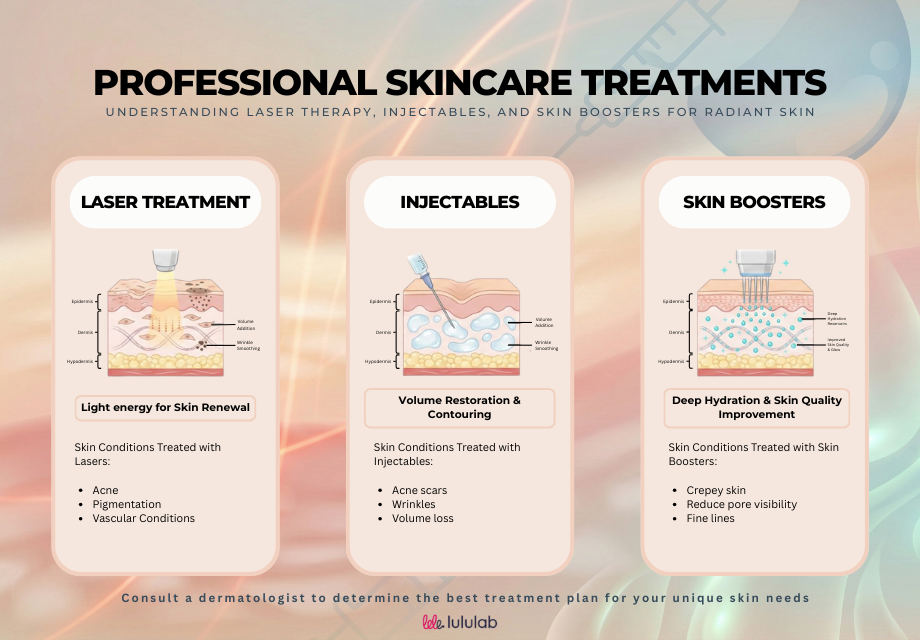
Skin Conditions Treated with Lasers
Lasers are incredibly versatile tools in a Korean dermatologist's kit. Depending on the wavelength used, we can target various issues.
- Acne: Laser treatment for acne scars is a gold standard in South Korea for smoothing uneven skin texture. Lasers can shrink oil glands to reduce sebum and kill Acne bacteria (C. acnes), preventing future breakouts.
- Pigmentation: Laser therapy for pigmentation—using ultra-short-pulse devices like Pico lasers—delivers energy in picoseconds to create a photoacoustic shockwave. This shatters pigment clusters into dust-like particles, which your body naturally flushes away without relying on excessive heat.
- Vascular Issues: For rosacea, broken capillaries, or spider veins, lasers heat the blood vessel until it coagulates and collapses, fading the redness over time.
You might wonder exactly what types of skin conditions do lasers treat; the answer spans from stubborn, deep acne scars to simple surface redness. This incredible range makes it one of the most reliable methods for the vast array of skin conditions treated with lasers today.
Injectables (Neuromodulators & Fillers)
"Anti-aging" is one of the purposes of injectables in Korean aesthetics. There is polishing, and then there is groundwork. This is divided into two technologies: Neuromodulators (Botox) and Derma Fillers (Hyaluronic Acid). These high-end treatments not only address structural concerns but also hydration, elasticity, and that radiant Korean glow that many desire.
How Skin Conditions Respond to Injectables
The response of skin to injectables depends entirely on whether we are treating a muscle or a volume deficit.
Neuromodulators (Relaxers): These inhibit the transmission of a signal between a nerve and a muscle. Understanding how botox affects different skin conditions is key. When you have deep lines (glabella), botulinum toxin is used to relax the muscles and prevent the skin from folding.
- Timeline: Relaxers generally take 3-5 days to take effect, and the full result can be seen in 2 weeks. In Korean skincare clinics, micro-dosing techniques, as practiced by dermatologists, help preserve natural expressions rather than freezing them.
Dermal Fillers (Volumizers): Volumizers are semi-gel substances that occupy space. Volumizers fill in the volume loss in hollow regions and lift sagging tissues caused by volume depletion.
- Timeline: Fillers show immediate results. The volume of your skin is back, and you leave the clinic with a smooth face, possibly with slight swelling, which will resolve after a few days.
Injectable Treatment Effects on Skin Conditions
A misconception among international patients is that fillers can fix everything. It is vital to understand that injectable treatments affect skin conditions structurally, not texturally.
- Restoring Facial Contour: Fillers are excellent for hollow eyes (tear troughs), deep marionette lines, and for flattening cheeks. They fix the "shape" of the face.
- The Texture Limit: Fillers generally do not remove sunspots. However, using dermal fillers for acne scars (specifically rolling scars) can be effective by lifting the depressed skin from beneath, though this is often combined with lasers for the best result.
Korean Pro Tip: For patients who want both pore reduction and lifting, Korean clinics often use "Skin Botox" (Dermatoxin)—a technique in which a diluted toxin is injected into the skin surface (not the muscle) to tighten pores and create a glass-like sheen.
Skin Boosters
If lasers handle the structural renovation and fillers provide the furnishings, consider Skin Boosters, the high-gloss finish that brings the room to life. In Korea, where the poreless, luminous 'Glass Skin' look is the ultimate benchmark, boosters are frequently the treatment of choice. Unlike traditional fillers that alter facial contours, boosters are dedicated exclusively to elevating Skin Quality.
How Skin Boosters Improve Skin Conditions
Many ask patients how skin boosters improve skin conditions differently from fillers. The answer lies in the product's texture. Injectable skin boosters for hydration (like Profhilo or the famous Korean "Rejuran Healer") have a low viscosity, meaning they are thin and fluid.
When injected, they function as an internal moisturizer. Instead of forming a lump, the product spreads evenly under the skin layer. This triggers bio-stimulation, signaling your cells to produce more elastin and collagen. They hydrate from the inside out, improving firmness without altering your natural facial contours.
Key Skin Boosters Benefits for Skin Conditions
The primary goal of a booster is to repair the skin's "fabric".
→ The "Glow" Factor: This is the quickest way to fix dullness and achieve that dewy, hydrated look seen on K-Drama stars.
→ Sun Damage Recovery: While they don't remove spots like lasers, the sun damage reaction to skin boosters is positive; the potent hydration and DNA repair (in the case of Rejuran) help heal the cellular damage caused by UV rays.
→ Restoring Elasticity: One of the main skin boosters benefits for skin conditions is the return of the "snap" to your skin. They are excellent for treating crepey skin, especially in delicate areas like the under-eye area or the neck lines.
→ Deep Hydration: For people who have problems with dehydration or dehydrated-looking skin, skin boosters deliver deep hydration that no cream can match.
- Timeline: The skin response timeline after boosters may include a period of settling of bumps (for people who use Rejuran) to the 'peak glow' which occurs around 2-3 weeks following therapy.
Korean Clinic Insight: In Seoul, it is common to combine a skin booster with a micro-needling treatment. This "cocktail" approach ensures the ingredients penetrate deeply for maximum regeneration.
Check out what your traditional skin type doesn't tell you and what AI skin analysis can do to help you find your perfect treatment match.
Comparative Analysis: Choosing the Right Tool
In Korean dermatology clinics, relying on a single procedure is rare. Instead, the K-Beauty philosophy emphasizes treating multiple skin layers simultaneously. This layered approach is a perfect example of how laser enhances injectable effectiveness. The structural improvements from injectables appear far more natural by clearing the canvas first. However, balancing these treatments requires careful planning around your results timeline and acceptable downtime.
Lasers vs Injectables for Skin Conditions
The easiest way to decide between these two is the "Texture vs. Volume" rule.
- Lasers fix the "Canvas": If you have problems such as enlarged pores, scars, or pigmentation, you should consider Laser Treatment.
- Injectables fix the "Structure": If your issue is with shadows, hollows, or deep folds, injectables are necessary to either fill or relax.
When evaluating pigmentation improvement with laser vs injections, the laser is the clear winner for removal, while injections (boosters) are better for overall skin brightness and health surrounding the pigment.
Downtime & Results: When comparing laser vs injectables for skin conditions, the biggest differentiator is the timeline. Fillers are great because they work in the background. Laser skin rejuvenation is different. It takes a week to see the results because the collagen in your skin needs time to change. This means you get skin that lasts, something injections cannot do. Achieving Laser skin rejuvenation outcomes gives you long-term improvement.
- Injectables are often called "lunchtime procedures" because you can usually return to daily activities immediately, with only minor risk of bruising.
- Lasers, particularly the ones used for scar removal, often come with "social downtime." You may experience redness or peeling for 3–7 days. Korean clinics often pair these with advanced soothing treatments (such as Cryotherapy) to speed up recovery for travelers.
Response of Skin Conditions to Laser Treatment vs. Boosters
This comparison is about Correction vs. Nourishment.
The response of skin conditions to laser treatment can be very corrective. These treatments are designed to directly target and resolve the problem—whether that means disintegrating the pigment in a sunspot or remodeling the uneven texture of scar tissue.
In contrast, Skin Boosters prevent and nourish. They don't attack; they feed. They are used for strengthening the Skin Barrier and reducing sensitivity.
- Active Acne: Lasers can treat active acne by killing bacteria, whereas boosters are generally avoided on inflamed, infected skin to prevent bacterial spread.
- Scar Remodeling: Lasers physically break down scar tissue. Boosters simply hydrate the tissue around it.
Ready to find the right dermatologist for these treatments? Explore our curated list of trusted Korean dermatology clinics to start your skincare treatment.
Conclusion
Each skin type is unique, and in Korean dermatology, knowing your own skin helps you determine the treatment that's best for you. Because skin is so distinctive, trying to guess what works best or what's merely popular can be, well, skin-deadening.
Modern Korean clinics now use AI skin analysis kiosks like those from Lululab, a Samsung C-Lab spin-off, to remove the uncertainty. These gadgets quickly scan your face using multispectral imaging to measure features invisible to the human eye, such as the exact depth of your wrinkles, the density of hidden pigment, and the degree of redness.
During a professional consultation, your dermatologist can use the data, which is aligned with Korean Board-Certified Dermatology Protocols, to determine with mathematical precision whether your skin will respond better to a booster's hydration, a filler's volume, or a laser's heat. This knowledge serves as the foundation for a thorough skincare plan that addresses everything from the actual procedure to crucial post-care actions like sun protection. A data-driven diagnosis for a perfect fit is more important than treatment alone.
"Don't guess with your face. Book an AI skin analysis today to find your perfect treatment match."
Frequently Asked Questions (FAQ)
Can I get lasers and injectables done on the same day?
In many Korean dermatology clinics, the answer is yes. Doctors often "stack" treatments, starting with energy-based devices (lasers) first, followed by soothing skin boosters or injectables. However, this depends entirely on the laser's intensity.
Will skin boosters change the shape of my face like fillers?
The goal of skin boosters, like Profhilo or Rejuran, is to improve your skin's appearance. They help with skin quality. They keep your skin hydrated and elastic. Skin boosters do not make your skin look fuller or change the shape of your face as traditional dermal fillers do. They help your skin look nicer and healthier. Skin boosters like Profhilo or Rejuran are really good for people who want to improve their skin.
Is AI skin analysis expensive?
Many top-tier clinics in Seoul include AI skin analysis as a part of the initial consultation to ensure accurate treatment planning.
How long does the redness from laser treatment last?
It depends on the laser type. Mild toning lasers may cause redness for only a few hours ("lunchtime procedures"), while aggressive resurfacing lasers for acne scars can cause redness and peeling for 3–7 days.
Which treatment is best for "Glass Skin"?
"Glass Skin" is usually achieved through a combination approach. These combinations involve a laser treatment to clear pigment, followed immediately by a skin booster treatment to flood the skin with hydration and create that signature glow.
Reference:
10 Benefits of Microneedling with Exosomes - Goldenberg Dermatology. https://goldenbergdermatology.com/microneedling/microneedling-with-exosomes-manhattan/
Skin Booster Treatment| Trusted Cosmetic Clinic at Gold Coast. https://rejuven8cosmetix.com.au/cosmetic-injections/hydrating-skin-boosters/